Culture
Unite teams around shared identity, strong relationships, and a clear sense of belonging.
Leadership support rooted in real school experience
Building one school, one culture, and one community.
Better Together Leadership grows from Derek Cantrell's experience bringing two rival schools together through consolidation and helping a new school community become stronger together. Derek helps leaders build practical systems for culture, data-informed decisions, instructional growth, and AI tools that save educators time.
Unite teams around shared identity, strong relationships, and a clear sense of belonging.
Turn dashboards and team conversations into decisions that support students and instruction.
Use AI thoughtfully to reduce workload, improve planning, and protect time for people.
Field-Tested Leadership
Derek's work is shaped by the lived experience of consolidation: helping students, staff, families, and community members move from uncertainty into shared pride. The lesson behind Better Together is simple and demanding: culture is built through what people feel, how they are treated, and what leaders reinforce every day.
About
Derek Cantrell is a high school principal at Alleghany High School in Virginia and the 2026 Virginia Association of Secondary School Principals (VASSP) Outstanding High School Principal of the Year.
He is a recognized leader in school culture, instructional innovation, and leading through change. With nine years of experience as a principal, he has played a key role in the successful consolidation of two rival high schools into one unified school community, building a strong and positive culture centered on connection, collaboration, and shared success.
Under his leadership, Alleghany High School has implemented impactful initiatives focused on student engagement, staff recognition, and academic improvement. His work emphasizes relationships, clear systems, and intentional culture-building to drive both academic and organizational success.
Derek is a frequent presenter at state and national conferences, including the Virginia Association of Secondary School Principals (VASSP) and the Making Schools Work Conference in New Orleans. He has also been featured on education leadership podcasts, including the Proud Principal Podcast, Principal Matters, and Better Leaders Better Schools.
In addition to his leadership work, Derek is an author and speaker focused on helping schools navigate change while maintaining a strong, people-centered culture. His message centers on the idea that schools are strongest when they operate with a shared vision and a commitment to being Better Together.

Better Together Philosophy
Culture is not one more thing on a leader's plate. It is the plate. Better Together Leadership helps teams turn shared values into repeatable leadership habits that make people feel seen, supported, and ready to grow.
Build trust through relationships, visibility, listening, and moments that help staff and students feel noticed and valued.
Create clear routines for communication, meetings, recognition, data conversations, and instructional follow-through.
Reinforce what matters daily so culture is taught, modeled, celebrated, and sustained beyond a single event.
The Book
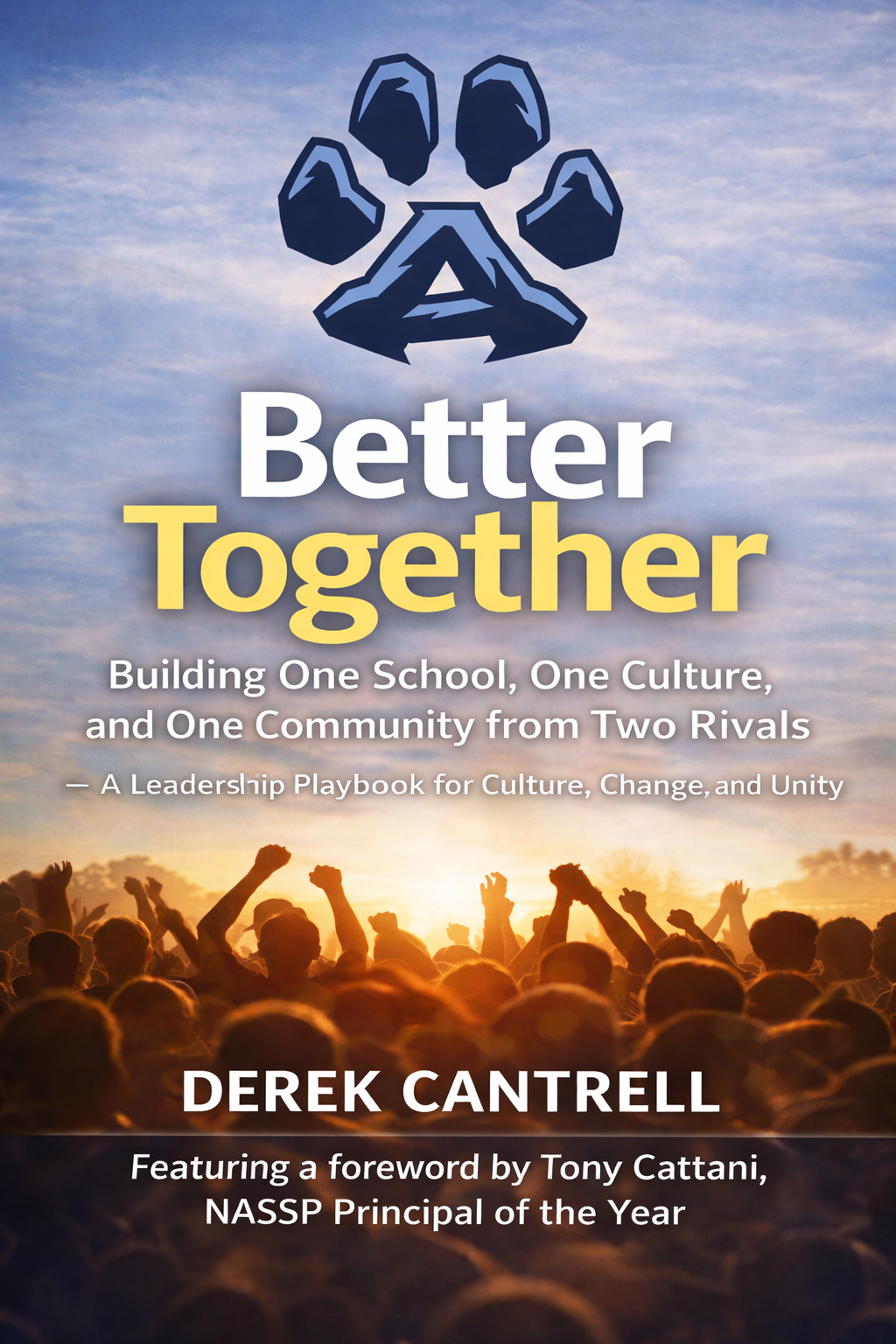
Derek's book tells the story behind the work: two proud rival high schools, decades of tradition, and the leadership challenge of helping students, staff, families, and a community build something new together.
The book is both story and playbook. It shares practical lessons on communication, trust, student voice, recognition, data leadership, AI in schools, daily positivity, and the first 90 days of leading change. Its central message is clear: culture does not happen by accident. It is built through daily choices, relationships, and consistent systems.
"If we didn't get the culture right, nothing else would work."
"Culture had to be intentionally built, day by day."
Presentations & Services
Practical support for schools and districts through keynote-style presentations, hands-on workshops, and ready-to-use leadership resources connected to culture, change, data, and AI.
Practical AI for educators who want to save time, improve feedback, strengthen instruction, and reinvest more energy in people.
Beyond Spreadsheets shows how school leaders can use AI to lead smarter, reduce paperwork, and create more time for people.
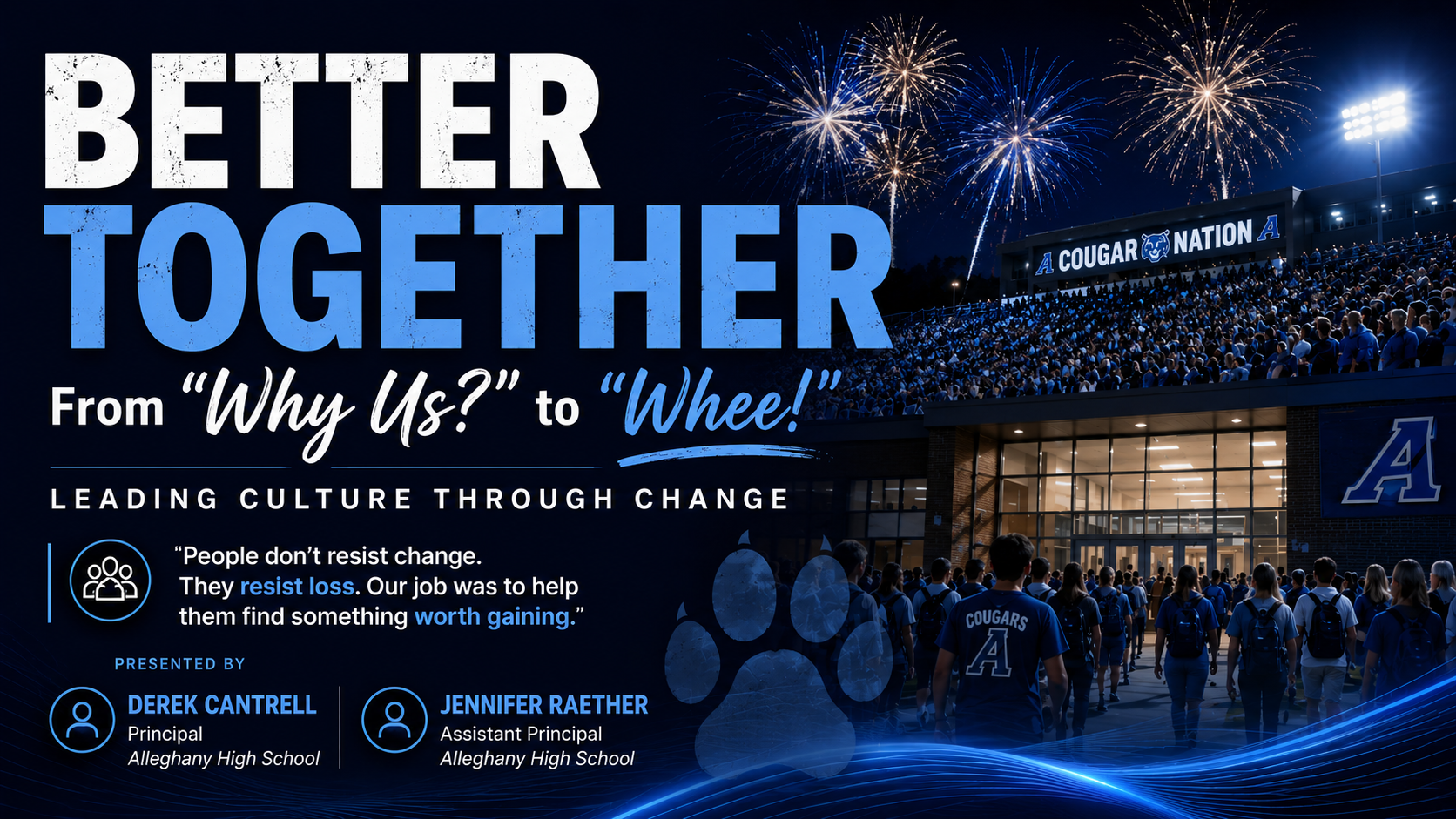
From "Why Us?" to "Whee!" shares the leadership story of building one school, one culture, and one community through change.
A practical workshop for leadership teams ready to strengthen culture, relationships, communication, and systems for lasting school improvement.
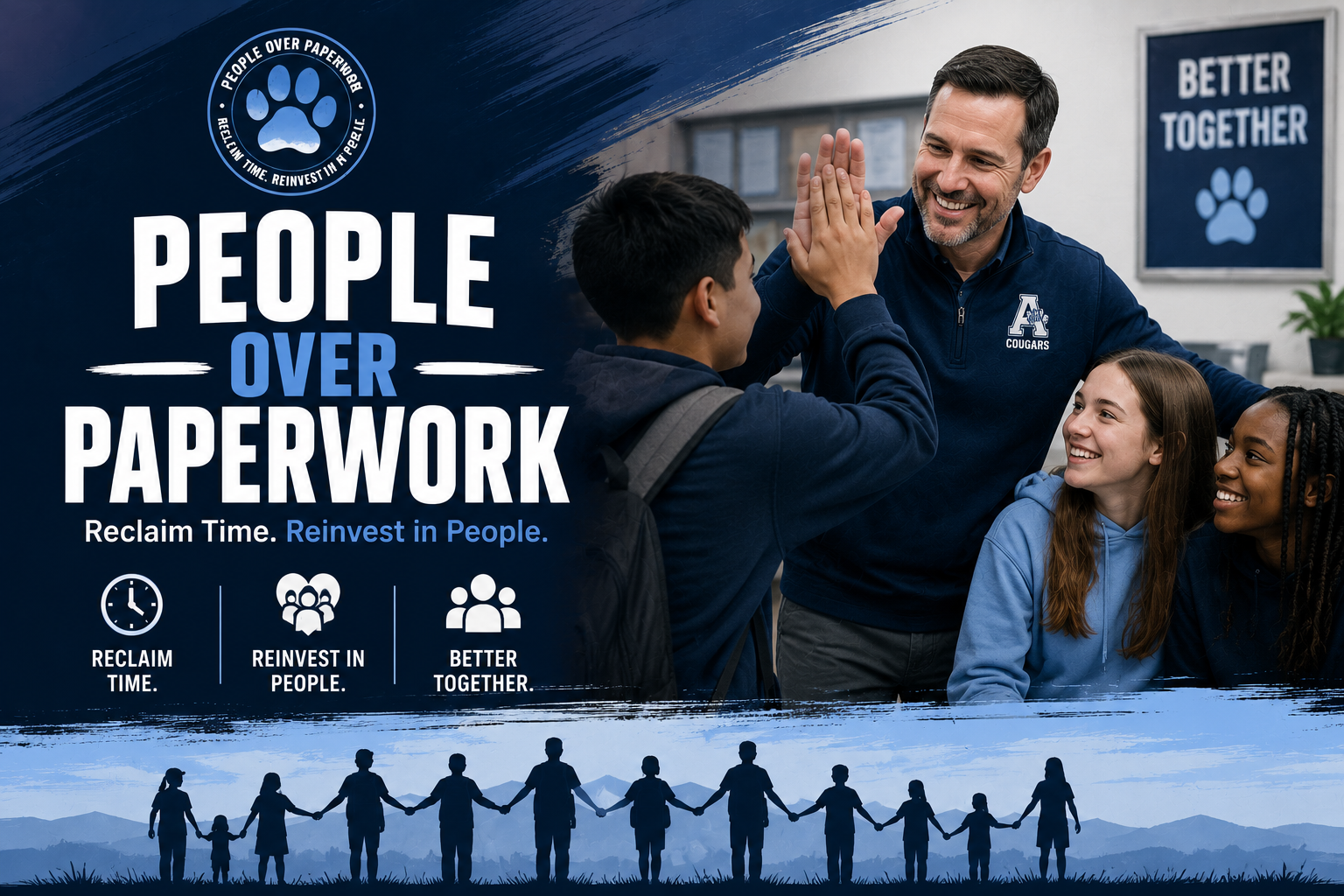
Book WorkshopPeople Over Paperwork
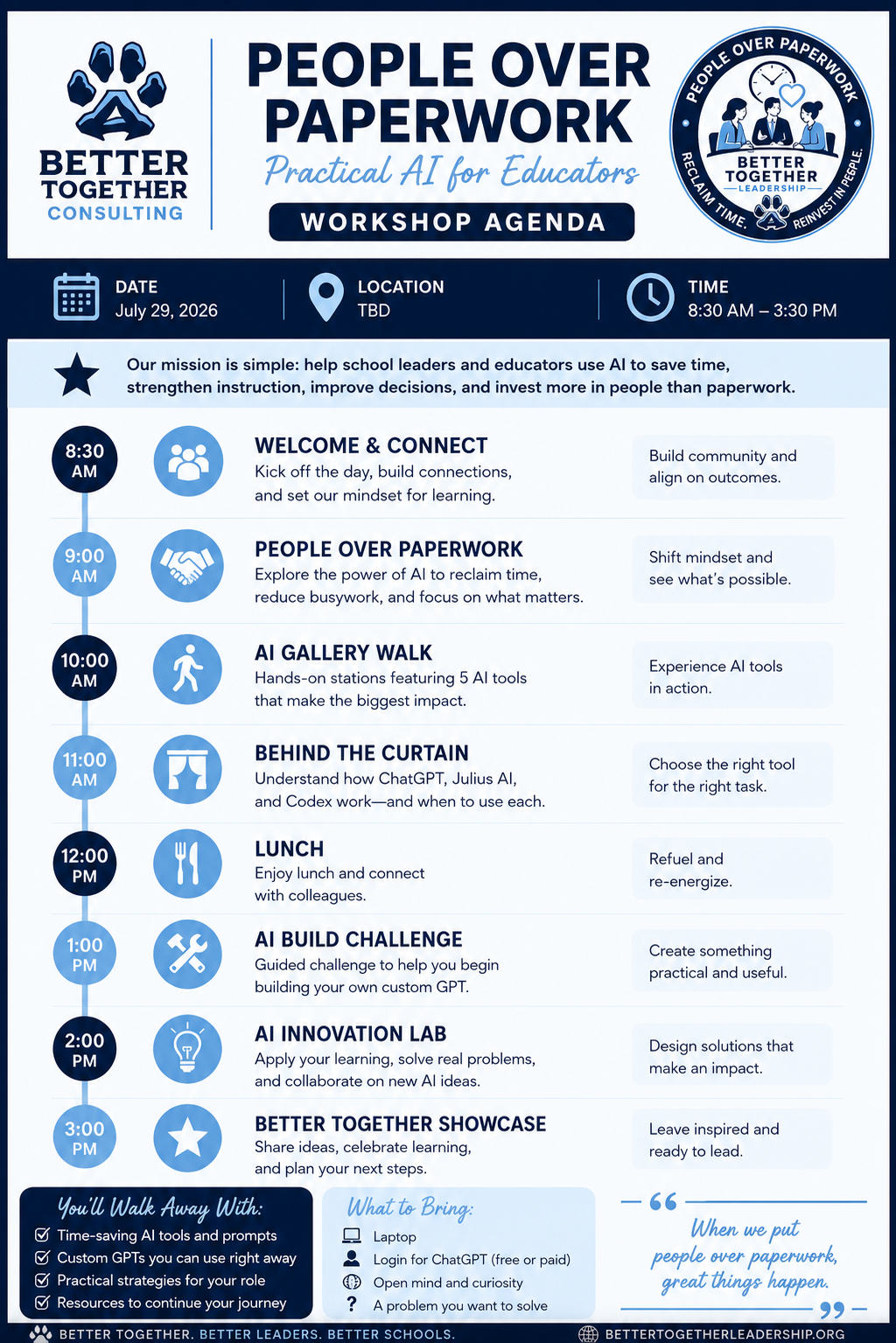
A full-day, hands-on workshop designed to help school leaders and educators use AI to reclaim time, strengthen instruction, improve decisions, and invest more in people than paperwork.
Workshop Resources
Schools that book the workshop receive an access code for slides, activities, sample data files, and AI Gallery Walk resources.
Code can be changed by editing the workshop access setting in script.js.
Unlocked Workshop Area
Add slides, participant handouts, and follow-up materials here as the workshop library grows. Start in the Activities section to open the AI Gallery Walk or the AI Build Challenge.
Open People Over Paperwork workshop slide decks.
Open hands-on workshop activities for participants.
Use these files during Station 4 for benchmark and growth analysis.
Biology Pre-Test Biology Benchmark 1 Biology SOL Post-TestAI Gallery Walk Activity
Participants rotate through five practical stations focused on feedback, lesson design, standards and assessments, data conversations, and leadership systems.
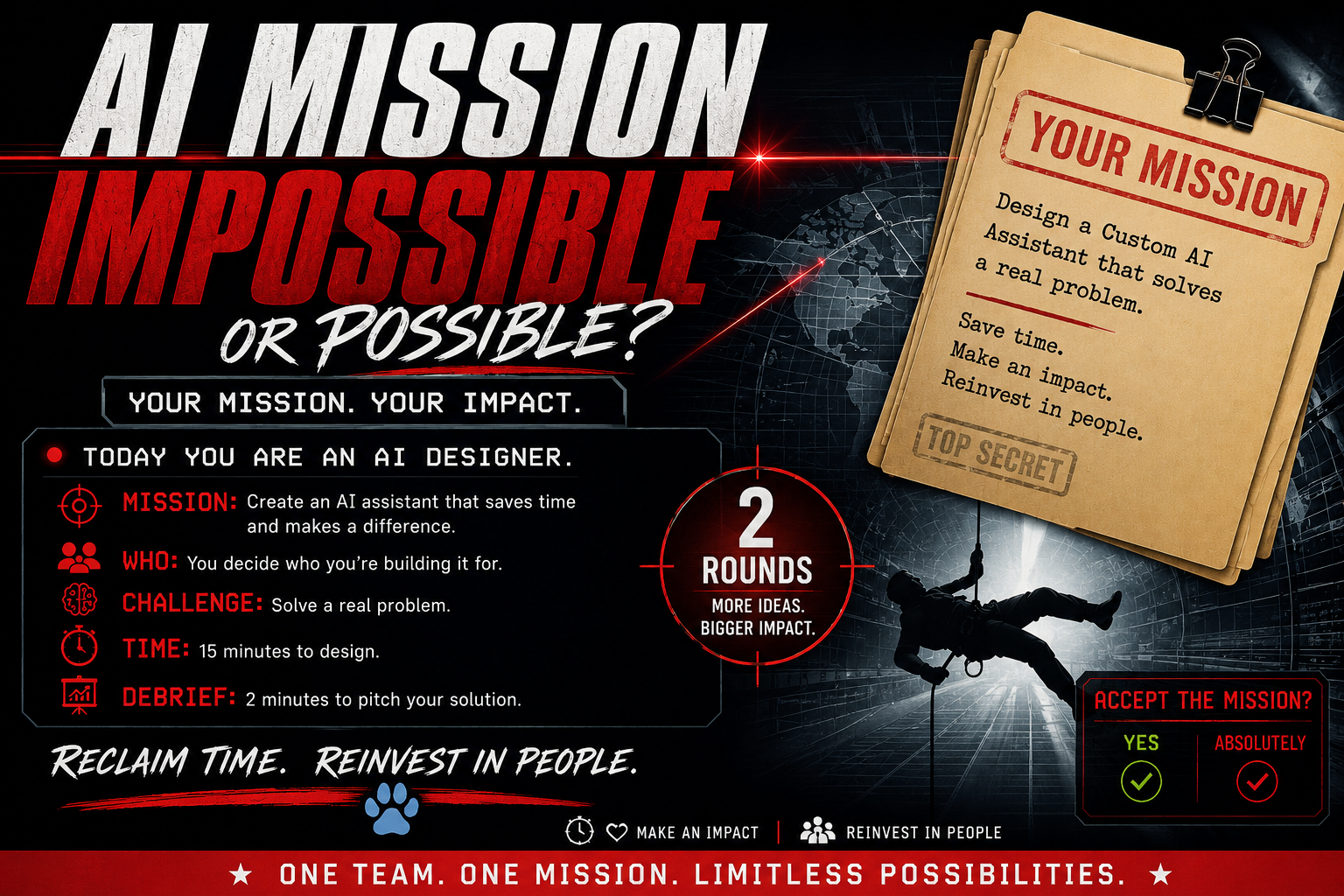
Mission: Turn quick classroom walkthrough notes into meaningful, growth-focused instructional feedback that supports teachers while saving administrators valuable time.
Purpose: Turn quick classroom walkthrough notes into meaningful, growth-focused instructional feedback that supports teachers while saving administrators valuable time.
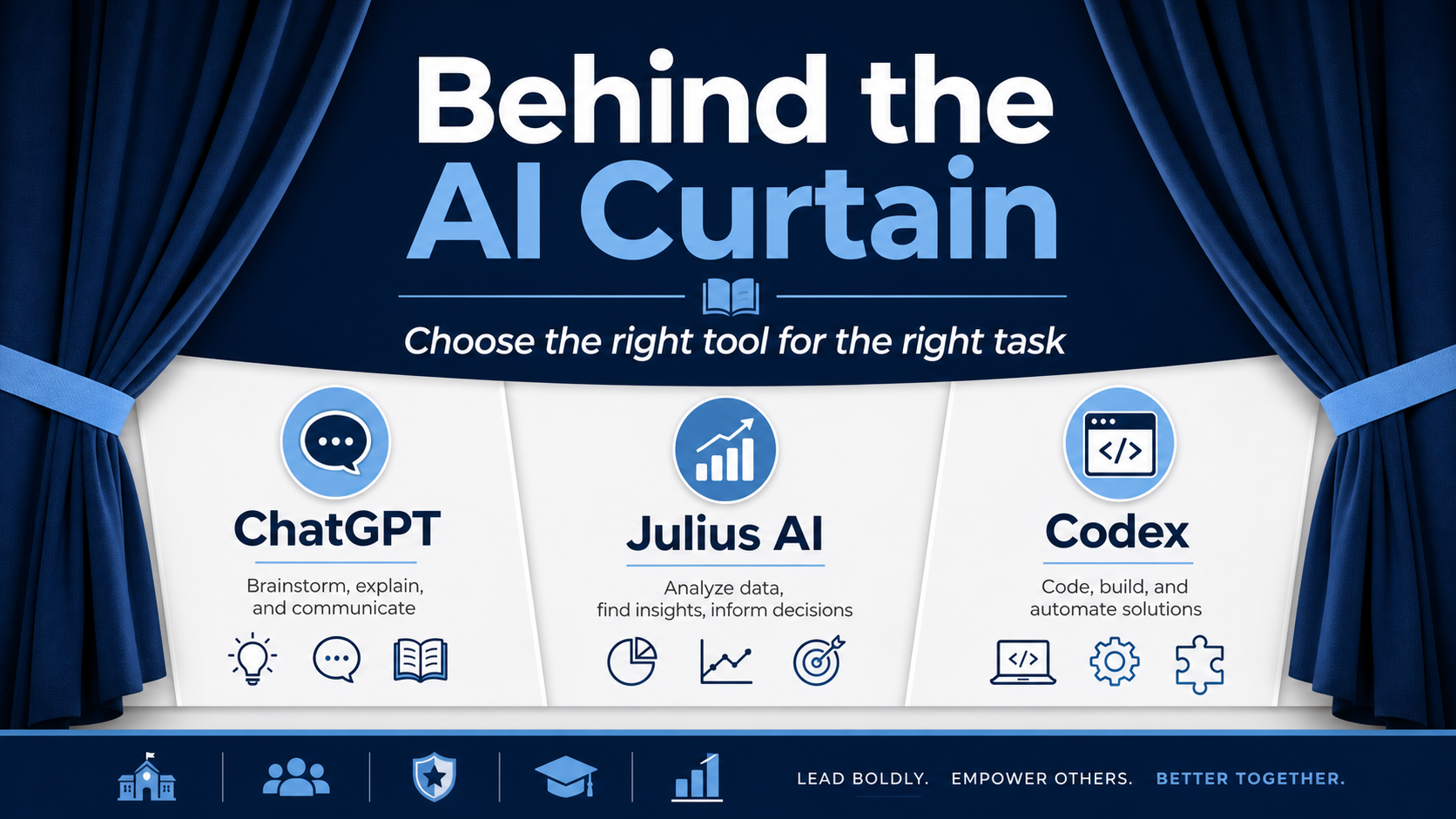
Copy and paste the prompt below into the GPT.
Please take my walkthrough notes below and generate professional walkthrough feedback focused on student engagement.
Include:
Teacher: Mrs. Emily Carter
Course: Algebra I
Walkthrough Focus: Student Engagement
9:18-9:28 walkthrough
Create a short email to the teacher that shares this feedback in a conversational, encouraging, and coaching-focused tone.
What are two or three high-impact coaching questions I could ask during a five-minute follow-up conversation with this teacher?
Purpose: Generate a comprehensive formal observation aligned to the Virginia Uniform Performance Standards from your classroom observation notes.
Copy and paste the prompt below into the GPT.
Please take my classroom observation notes below and provide professional comments aligned to all eight Virginia Uniform Performance Standards.
Teacher: Mr. Michael Reynolds
Course: Biology I
Learning target posted: Students will compare photosynthesis and cellular respiration using evidence from today's lab.
Possible growth areas:
Add more depth to the comments by including additional evidence from the observation and explaining the instructional impact.
Design a post-observation conference agenda based on this observation.
Include:
What are the strongest coaching points I should discuss during the post-observation conference?
Reflection: Discuss with your partner:
People Over Paperwork Reflection: If this station saved you 30 minutes every week, how would you reinvest that time in your teachers or students?
Mission: Great instruction begins with great planning. These AI tools help teachers create engaging, standards-aligned lessons and serve as an instructional coach by evaluating lesson quality before students ever walk into the classroom.
Purpose: Create engaging, standards-aligned Virginia lesson plans that include best instructional practices, differentiation, formative assessment, and student engagement.
Copy and paste the prompt below into the GPT.
Create a complete Virginia SOL lesson plan using the information below.
Include:
Course: Algebra I
Virginia SOL: A.4 - The student will solve systems of linear equations in two variables using graphing and algebraic methods.
Lesson Topic: Solving Systems of Equations by Graphing
Class Length: 90 Minutes
Student Needs:
Revise this lesson to increase student engagement and collaborative learning opportunities.
Suggest three formative assessment strategies I can use throughout the lesson to check for understanding.
Create differentiated supports for struggling learners and enrichment activities for students who master the content early.
Purpose: Evaluate lesson plans for standards alignment, rigor, student engagement, instructional flow, cognitive demand, differentiation, and overall lesson effectiveness.
Think of this GPT as your instructional coach.
Copy and paste the prompt below into the GPT.
Please evaluate the lesson plan below.
Analyze:
Provide strengths, areas for improvement, and specific recommendations.
Teacher: Mrs. Ashley Roberts
Course: Algebra I
Lesson Length: 90 Minutes
Virginia SOL: A.4 - Solve systems of linear equations in two variables using graphing and algebraic methods.
Learning Target: I can solve systems of equations by graphing and explain why the point of intersection represents the solution.
Essential Question: How can multiple methods be used to determine whether two relationships share the same solution?
Success Criteria:
Bell Ringer: Students analyze two graphs and predict where they will intersect. Students complete a Turn and Talk discussing: "What do you notice?" and "What do you wonder?"
Direct Instruction (I Do): Teacher models solving one system using Desmos while thinking aloud. Students predict each next step before it is completed.
Guided Practice (We Do): Students solve progressively more difficult systems with partners. Teacher circulates asking probing questions instead of providing answers.
Collaborative Learning (You Do Together): Groups solve a real-world ticket sales problem. Students create chart paper explaining their mathematical process, supporting evidence, and why their solution works. Groups participate in a gallery walk and provide peer feedback.
Checks for Understanding:
Differentiation Supports: Graphic organizers, color-coded graphs, and sentence stems.
Extensions: Three-variable systems and students create their own real-world application.
Assessment: Students complete an exit ticket requiring them to solve, explain, and defend reasoning.
Reflection: Students complete "I used to think..." and "Now I think..."
Use the same beginning prompt above.
Teacher: Mr. Jason Miller
Course: Algebra I
Lesson Length: 90 Minutes
Virginia SOL: A.4
Learning Target: Students will learn systems of equations.
Bell Ringer: Finish yesterday's homework.
Direct Instruction: Teacher lectures using PowerPoint for approximately 35 minutes. Students copy notes into their notebooks. Teacher demonstrates four examples while students watch.
Guided Practice: Teacher completes two additional examples with the class. Students volunteer answers when called upon.
Independent Practice: Students complete twenty textbook problems independently.
Student Engagement: Students raise their hand if they need assistance.
Checks for Understanding: Teacher asks, "Does everyone understand?"
Assessment: Students solve one system of equations for an exit ticket.
Differentiation: Students who finish early complete additional textbook problems. Students needing help may ask the teacher.
Closure: Teacher reminds students homework is due tomorrow.
Compare Lesson Plan A and Lesson Plan B.
Which lesson demonstrates stronger alignment, engagement, rigor, and instructional effectiveness?
Use specific evidence from each lesson to support your analysis.
Rewrite Lesson Plan B so it reflects high-quality instructional practices while remaining realistic for a 90-minute Algebra I lesson.
Keep the same Virginia SOL and lesson topic.
If you conducted a classroom walkthrough during each lesson, what instructional evidence would you likely observe in Lesson A versus Lesson B?
Reflection: Discuss with your partner:
People Over Paperwork Reflection: If AI could help you strengthen every lesson before it was taught, how would that improve student learning while giving you more time to focus on students instead of paperwork?
Mission: Great instruction begins with a deep understanding of the standard. Great assessments ensure students demonstrate the intended learning.
These AI tools help educators unpack standards, identify what students must truly know and do, and evaluate whether assessments accurately measure student learning.
Purpose: Break a Virginia SOL into clear learning targets, essential understandings, vocabulary, misconceptions, and instructional priorities.
Copy and paste the prompt below into the GPT.
Please unpack the Virginia SOL below.
Include:
Virginia Mathematics SOL A.4
The student will solve systems of linear equations in two variables using graphing and algebraic methods.
The student will:
Create three student-friendly "I Can" statements from this standard.
What misconceptions do students commonly have when learning this standard, and how can teachers proactively address them?
Design three engaging classroom activities that would help students master this standard.
Purpose: Evaluate teacher-created assessments for alignment, cognitive demand, rigor, and balance to ensure students are being assessed on the intended learning.
This assessment intentionally includes both strengths and weaknesses.
Before asking AI to evaluate it, discuss with your partner:
Then compare your observations with the GPT's analysis.
Copy and paste the prompt below into the GPT.
Please evaluate the assessment below.
Analyze:
Provide strengths, areas for improvement, and specific recommendations.
Algebra I Quiz
Virginia SOL A.4
Systems of Linear Equations
Directions: Answer all questions. Show your work where appropriate.
Identify which questions are well aligned to the Virginia SOL and which questions should be revised or removed.
Explain your reasoning for each.
Rewrite this assessment so every question aligns to the intended Virginia SOL and includes an appropriate balance of procedural fluency, conceptual understanding, application, and mathematical reasoning.
Classify each assessment question using Webb's Depth of Knowledge (DOK).
Explain why each question fits that level and identify where additional rigor is needed.
Station Reflection: Discuss with your partner:
People Over Paperwork Reflection: How could using AI to unpack standards and evaluate assessments before instruction begins improve student learning while saving teachers valuable planning time?
Better Together Challenge: Think about one assessment you use every year. Does it truly measure the intent of the standard? Are students explaining their thinking or simply recalling information? Is there an appropriate balance of procedural fluency, conceptual understanding, and application? How could these AI tools help strengthen that assessment before your students ever take it?
Mission: Turn assessment data into meaningful instructional decisions.
These AI tools help educators quickly identify trends, prioritize instructional needs, organize intervention groups, and create actionable next steps from assessment data.
Purpose: Analyze assessment data and transform it into actionable instructional recommendations.
Copy and paste the prompt below into the GPT.
Please analyze the assessment data I uploaded.
Upload:
Participants can upload one file or all three to compare growth.
Identify the greatest student strengths and the highest-priority instructional needs.
Create intervention groups and recommend instructional strategies for each group.
Compare the pre-test, benchmark, and post-test.
Highlight student growth, remaining learning gaps, and instructional trends.
Purpose: Transform assessment data into productive PLC conversations focused on improving instruction and student learning.
Copy and paste the prompt below into the GPT.
Please use the assessment data I uploaded to create a PLC discussion.
Use the same uploaded assessment files from the previous activity.
Create a 45-minute PLC agenda based on these assessment results.
What are the biggest misconceptions students have, and what instructional strategies should teachers consider during reteaching?
Develop a two-week reteaching plan and identify evidence teachers should collect to monitor student progress.
Station Reflection: Discuss with your partner:
People Over Paperwork Reflection: If AI could prepare your benchmark analysis, intervention groups, and PLC agenda in just a few minutes, how would you reinvest that time to better support teachers and students?
Better Together Challenge: Imagine tomorrow is your PLC meeting. Instead of spending the first 30 minutes sorting through spreadsheets, you already have performance trends, student growth analysis, suggested intervention groups, priority standards, reteaching strategies, and a ready-to-use PLC agenda. How would that change the conversation?
Mission: Great schools improve through intentional leadership - not just more meetings.
These AI tools help school leaders analyze instructional needs, develop action plans, strengthen walkthroughs, and focus coaching conversations around what matters most.
Purpose: Develop improvement plans, testing plans, leadership action plans, and implementation timelines aligned to school priorities.
Copy and paste the prompt below into the GPT.
Please help me develop a school improvement action plan using the information below.
School: Jefferson High School
Enrollment: 1,120 Students
Recent Benchmark Results:
Walkthrough Trends:
Teacher Feedback:
School Goal: Increase student engagement, academic discourse, and instructional rigor while improving mathematics achievement.
Develop a 30-day leadership action plan with specific weekly priorities.
Identify the three highest-impact leadership actions that would improve instruction across the school.
Create an agenda for a leadership team meeting focused on implementing this improvement plan.
Purpose: Develop a shared instructional vision by identifying evidence of high-quality instruction and strengthening coaching conversations.
Copy and paste the prompt below into the GPT.
Please help me identify instructional priorities and develop walkthrough look-fors using the information below.
Recent classroom walkthroughs revealed several instructional trends.
Observed Strengths:
Areas for Growth:
Leadership Goal: Develop a consistent instructional focus across the school that increases student engagement, academic discourse, and deeper thinking.
Develop a walkthrough observation tool focused on these instructional priorities.
Create five coaching questions I could use during post-walkthrough conversations with teachers.
Develop a faculty professional learning session that addresses these instructional needs.
Station Reflection: Discuss with your partner.
People Over Paperwork Reflection: If AI helped you spend less time writing plans and preparing meetings, how could you reinvest that time to better support teachers and students?
Better Together Challenge: Imagine tomorrow morning. Instead of spending an hour creating school improvement plans, leadership meeting agendas, walkthrough focus documents, coaching questions, and professional development plans, they're already waiting for you. What could you do with that extra hour?
Workshops
Each session can be adapted for school-based teams, district cohorts, leadership retreats, conferences, or consolidation culture work.
Outcomes: Identify practical AI use cases, draft time-saving prompts, and plan next steps for responsible implementation.
Format: Interactive half-day session with demonstrations, guided practice, and planning time connected to real leadership work.
Outcomes: Build and test custom GPT concepts for school workflows, communication, staff support, and instructional planning.
Format: Full-day design lab with examples, build time, feedback, and implementation planning.
Outcomes: Connect AI tools, dashboard design, data routines, and leadership systems into a plan that supports students and saves time.
Format: Two-day institute with templates, team collaboration, and facilitated action planning.
Outcomes: Clarify adult culture priorities, strengthen relationships, and design systems that help a school become one community.
Format: Keynote, half-day, full-day, or retreat format with reflection, examples, and action planning.
Resources
Resources designed to help schools continue the Better Together work through book study, time-saving AI tools, and practical leadership systems.
Coming Soon
Continue the Better Together journey with a leadership book study designed for schools and districts.
Facilitator guides, discussion questions, implementation resources, and leadership activities that help schools build one culture and one community.
Learn MoreA collection of custom GPTs and AI tools designed to save school leaders and teachers time while improving instruction, communication, and school leadership.
Practical AI tools built specifically for educators to reduce paperwork and increase time with people.
Leadership systems, templates, and resources that help schools recognize, acknowledge, and extend the great things happening every day.
Practical leadership systems for building culture, strengthening relationships, improving communication, and creating lasting school improvement.
Protected Pilot Downloads
Secure full-install and update downloads for approved schools using the Graduation Intelligence Center.
The system helps counselors and administrators monitor graduation requirements, retesting needs, credentials, readiness indicators, and local reporting.
Protected Downloads
Password-protected downloads for pilot schools using local assessment, tracker, and grade extraction tools.
Each tool is designed to help school teams organize data, streamline daily systems, and keep sensitive student information on the school-controlled device.
People Over Paperwork
These custom AI tools help educators save time, improve feedback, and streamline lesson design, data analysis, and planning. Each one is live and ready to explore today.
Generates positive, actionable, and growth-based walkthrough feedback aligned to observation notes.
Supports teachers with SOL-aligned math questions, reteaching ideas, and assessment design.
Builds complete SOL-aligned lesson plans with objectives, strategies, and checks for understanding.
Generates color-coded K-12 data reports with DOK analysis, growth tracking, and next steps.
Drafts, organizes, and refines school improvement and testing plans aligned to priorities.
Evaluates teacher-made assessments for alignment, cognitive demand, and standard balance.
Reviews lesson plans for rigor, engagement, and Depth of Knowledge levels.
Breaks down Virginia SOLs into key understandings, essential questions, and student-friendly learning targets.
Provides PLC discussion prompts based on SOL data, trends, and misconceptions.
Creates detailed, rubric-aligned observation summaries with a professional and constructive tone.
Reviews lesson plans for alignment to standards, learning targets, and rigor.
Converts assessment or spreadsheet data into reteaching strategies, groupings, and PLC prompts.
Analyzes lessons for instructional flow, engagement opportunities, and cognitive complexity.
Creates Virginia SOL multiple-choice assessments aligned to standards, blueprints, and released items.
Helps develop a shared observation lens focused on feedback, discourse, and the instructional core.
Better Together
Practical systems, templates, and examples for communication, belonging, recognition, partnerships, adult learning, and staff voice.
Tools and planning documents for building culture through student voice, communication, and shared leadership.
Demonstrates how student voice informed planning, culture, and transition decisions.
Engages families through updates, tradition-honoring, questions, and partnership.
Questions for listening to families and students during thoughtful, student-centered consolidation.
Captures student feedback on expectations, concerns, attendance factors, supports, and culture-building.
A weekly lunch initiative that builds belonging, wellness, leadership, and career readiness.
Pairs students with caring staff navigators to build relationships and improve attendance.
A monthly recognition initiative celebrating excellence, kindness, leadership, and school pride.
A tiered recognition program that celebrates students who meet SOL requirements early.
A step-by-step guide for launching a school podcast that elevates student and staff voice.
A culminating recognition for seniors demonstrating academics, service, leadership, and future readiness.
Tiered partnership opportunities supporting incentives, culture, and recognition programs.
A structured peer observation model for reflective practice and continuous instructional improvement.
Captures staff voice, passions, needs, and supports to guide culture-building decisions.
Graduation Intelligence Center
Approved schools can download a complete portable installation or update an existing Graduation Intelligence Center installation. Both downloads require the school access code provided by Better Together Leadership.
The Graduation Intelligence Center is a secure, locally operated student graduation tracking system designed for school counselors and administrators. It combines assessment results, transcripts, verified credits, credentials, readiness indicators, and local graduation requirements into clear student profiles and class grids.
The system helps schools identify missing requirements, monitor retesting needs, create graduation agreements and checklists, resolve unmatched records, and generate Excel and PDF reports. School data remains on the school-controlled computer or district server and is not sent to the developer, cloud analytics, or external AI services.
The program is currently being piloted with school divisions to evaluate usability, data accuracy, reporting, and local implementation.
New schools: Download the Version 2.0 RC8.13 Portable Full Install package. This includes the files needed for a new portable installation.
Existing schools: Download the Version 2.0 RC8.13 Update package and follow the steps below. This package is for schools that already have the Graduation Intelligence Center installed.
Watch this step-by-step walkthrough before updating an existing school installation.
Current protected release: Graduation Intelligence Center Version 2.0 RC8.13.
Protected Pilot Downloads
This protected area gives approved schools access to local, school-operated tools for assessment analysis, progress tracking, and grade extraction systems.
Enter the school access code provided by Better Together Leadership. Downloads are intended for approved pilot or partner schools.
Additional school-specific codes can be added in the protected download route as new partner schools join the pilot.
Assessment Reports
A local, code-only tool for turning item-level assessment exports into clean Excel reports with mapped columns, counts, percentages, teacher and group summaries, strengths, weaknesses, and optional student-level tabs.
Student data stays on the user device and is not sent to AI or external services.
PowerSchool Export
A standalone Windows application that converts a PowerSchool Student Schedule Listing PDF into a formatted Excel workbook with course, teacher, grade, period, summary, distribution, and review worksheets.
No Python installation, cloud service, or internet connection is required.
Math Tracker
A locally hosted tracker for math rosters, historical and current SOL scores, pre-tests, benchmarks, post-tests, course grades, imports, student matching, predictions, color-coded levels, recommendations, and backups.
Uploaded student data is processed locally and is not sent to AI.
Science Tracker
A shared, secure tracker for Science rosters, historical SOL scores, pretests, benchmarks, grades, and student progress across multiple Science courses.
Supports Excel and CSV imports, yearlong classes, configurable assessments, and color-coded results.
English Tracker
A shared, secure tracker for English 9-12 and dual-enrollment courses with Reading and Writing SOL history, pretests, benchmarks, post-tests, grades, and Grade 11 EOC Reading readiness.
Includes Excel and CSV imports with color-coded progress views.
Testimonials
"A must read for all school administrators."
Jerry Seeger, Amazon review
"This is an important book... for any principal who wants to create a family atmosphere."
Amazon Customer, Amazon review
"Culture is not built through programs or slogans, but through daily actions."
Jennifer Raether, Amazon review
"Invaluable to any school that wants to develop a culture of positivity."
Jaclyn Jones, Amazon review
Podcast & Media
Explore Derek's school podcast, guest conversations, news features, and conference sessions about culture, consolidation, leadership systems, and practical change.
Featured Podcast
A school podcast sharing stories, voices, and practical leadership lessons from the work of building one school, one culture, and one community.
Building culture and leading through change.
ListenBetter Together with Derek Cantrell.
Apple Podcast YouTubeHow one principal united two rival high schools.
ListenConnection strategies for turning pressure into power.
WatchEducator spotlights book about reshaping a school division.
Read / WatchA conversation on the Better Together story.
WatchBetter Together with Derek Cantrell.
ListenA principal's perspective on school leadership.
ListenLeadership habits that create a unified, powerful school.
WatchPractical leadership conversation with Derek Cantrell.
ListenA conversation on the Better Together story, school culture, leadership through change, and practical ways AI can help educators spend more time with people and less time on paperwork.
WatchBuilding One School from Two Rivals with Derek Cantrell - a conversation about leading through change, building trust, and creating one unified school culture.
ListenWhat Happens When Two Rival High Schools Become One? Lessons in leadership from Virginia's Outstanding Principal of the Year.
Read ArticleEpisode 77: How to successfully merge two rival high schools with leadership lessons from Derek Cantrell.
Listen Watch VideoHow two principals are designing professional learning that sticks, with practical leadership lessons for building stronger adult learning.
Read Article ListenA conversation on leading change proactively, honoring the past while building a shared culture, and using AI to create more time for people and relationships.
ListenDerek shares the Better Together story of uniting two longtime rival high schools into one community and the leadership lessons learned along the way.
ListenDerek joins Dr. Melissa Sadorf to share how people-first leadership, trust, transparent communication, and a Better Together mindset helped unite two longtime rival rural high schools into one community.
Watch on YouTube Listen on SpotifyContact
Share a few details about your school, district, or event. Better Together Leadership can follow up about bringing teams together, workshops, speaking, AI implementation, dashboards, culture, or practical leadership systems. Pricing is handled off-site after the scope, format, and travel needs are discussed.